Showing posts with label eco. Show all posts

Thursday, 28 February 2013

butterflies


I had butterflies in my tummy before I went back to work. How fitting then, that on my first day I wore a blouse that I made myself from this butterfly print fabric. This butterfly print fabric that comes from a French Connection blouse that I picked up at Buffalo Exchange in the U District completely on a whim because I loved the fabric and thought that I could make something out of it.

Unfortunately, with a couple of muck-ups along the way, I wasn't able to make something out of it alone because I ran out of fabric and then had to stalk ebay to buy another dress and another blouse and a skirt too actually because the previous owner washed the dress with something nigh corrosive and the fabric was bleached out and ... suffice to say, there were no savings made here, fabric-wise.

But the fabric is gorgeous. You can ever so faintly see the self-stripe, it's 100 per cent cotton, great weight and drape, adorable print and no, doesn't suit me at all. I've mostly always worn single colour tops and blouses and t-shirts and there's a reason - I'm just not a printed blouse wearing sort. I did wear it to work, the first day, but only out of pure obstinacy because, yes, I'm like that.

ps: And those pre-first-day-back-at-workbutterflies? It took ten days and a dose of antibiotics to get rid of them. Ugh.

Thursday, 10 January 2013

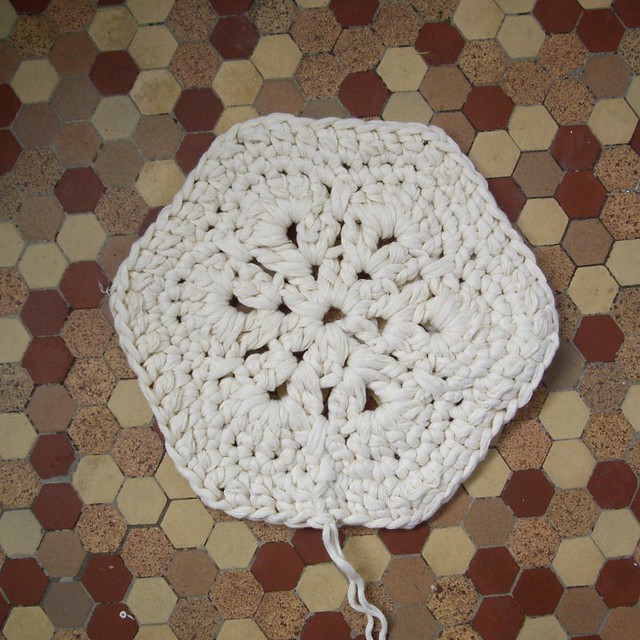
chunky crochet

One of these is still catching up with 2012, the other I just completed today.


The Vital Statistics
African Flower Hexagon Crochet Tutorial by Heidi Bears.
Size: One size; the bathmat you could make larger by working extra rounds.
Yarn: Moda Vera Beetle (50 per cent cotton, 50 per cent acrylic) in a particularly unpleasant shade of pink, eight strands held together, used five skeins; and off-white recycled cotton/acrylic, 2 strands held together.
Hook: 15mm and 10mm, respectively.
Start to finish: 16 December to 23 December 2012; 9 January to 10 January 2013.
Stash/recycle content: The African Flower motif was made from yarn recycled from a Perry Ellis sweater that I bought at Sacred Heart Mission Op Shop for $5.

Comments: I decided that we needed some bathmats, and because it's quick, I opted to try a couple out in crochet, and in a cotton/acrylic mix because I thought that it would dry and wear better. These are two free patterns so the quality of the instruction is a bit uneven.  The Ooty pattern is not very sophisticated (doesn't include instructions for turning chains) and the African Flower pattern goes into so much (extraneous) detail that it's almost confusing (clearly for absolute beginner or very nervous crocheter).

Verdict: Not great successes. The pink one has already met its demise (rubbish bin; couldn't stand the colour and shouldn't have worked with it in the first place but it was the best of a poor selection) and I will probably unravel the off-white motif in order to knit with it instead. There are many gorgeous examples of the African Flower motif out there, I think that doing it in an assortment of colours really helps.

Both projects were reasonably quick to make but the actual mechanics of working with such bulky yarn doesn't make for an enjoyable crafting experience and there's just not enough definition in chunky crochet (or maybe it's the cotton/acrylic mix). Won't be trying this again.

Tuesday, 14 August 2012

m2818 AA v.2

Palmer Pletsch for McCall's 2818
Alma Aguilar version 2

And here is version 2, with a differently cut yoke and the same gaping problem.


Again, fits very nicely across the bust - hooray! I cut the yoke across the princess seams just above the bust apex and the neckline even deeper and wider and it does sit ok if allowed to sit very wide on my shoulders (much wider than I would like, strapless-bra required wide) and I haven't done the understitching on the neckline yet and it doesn't have sleeves, which do tend to pull things into shape, but I have run out of fabric until I can find another French Connection butterfly print top on ebay and ...

It also occurs to me that this is a semi-fitted pattern. I'm wondering if that doesn't lend itself to a deep neckline. Anyway, I'm going to put this one away for (maybe) later.

(Final lesson learned - maybe those late-night dressmaking sessions are not such a good idea.)

Monday, 13 August 2012

m2818 AA v.1

Palmer Pletsch for McCall's 2818
Alma Aguilar version 1

This is what I have spent a lot of time working on recently - a lot of time adjusting the pattern with a full bust adjustment (fba) (it took me four tries but I got it right), then sewing a toile, then altering the neckline, then cutting and pinning and sewing and facing and interfacing.


And, I'm afraid, it has not wholly been a success. I have a litany of little woes to recount about this project; oh where to start? With a positive - the fba turned out very well and now that I am confident with that I will not hesitate to do it again. Hooray! This Palmer Pletsch pattern includes all of the lines upon which you need to cut in order to make the adjustments and it is really easy. Double hooray!

The greatest problem that I encountered here was with the neckline and I must note that I altered it in an effort to emulate the Alma Aguilar dress of my dreams and perhaps that is where it all went wrong? Anyway, the neckline gapes (see fuzzy middle image), that is, doesn't sit flat against my chest. This may be an issue with the original pattern, unfortunately I never completed my toile of that far enough to assess the neckline, I was too focussed on getting the fba perfected. I cut my neckline a lot deeper than that in the pattern, not sure whether a deeper neckline calls for tightening up elsewhere - would need to make a toile again to assess that but I am very over this sewing pattern. I also made some mistakes with interfacing and sewing the yoke and I had a lot of trouble with the facings and the sleeves aren't finished because I absolutely ran out of steam and ... in short, I've had it with this one.

I did have some fun with the back though - the pattern calls for a placket up the back and I was planning on using an invisible zip at the side but since I was upcycling a men's shirt I just cut the back pieces from the front of the shirt and incorporated the placket. I left the chest pocket on the shirt and you can (sort of, just) see where that is incorporated into the princess seams.

Tuesday, 31 July 2012

fifth course

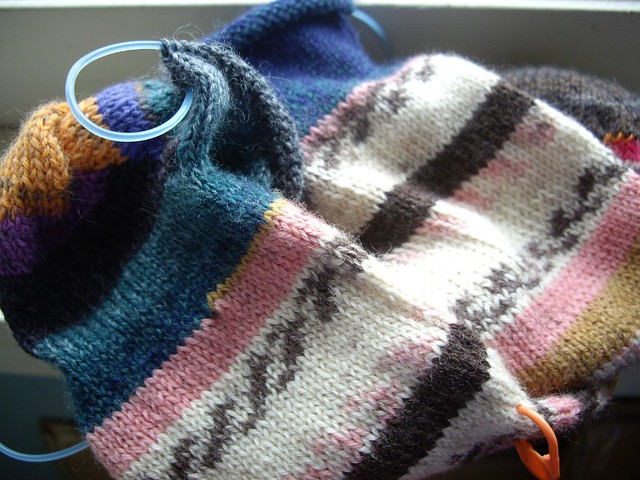
I've been randomly knitting away on Tim's secret pink stripe smorgasbord delicious socks. I'm up to the fifth different yarn and they're coming along nicely. Just stocking stitch in the round for a while now, then ribbing I guess. I don't think I'll even need to do any shaping as they are certainly not going to be knee highs (as the pattern accommodates).


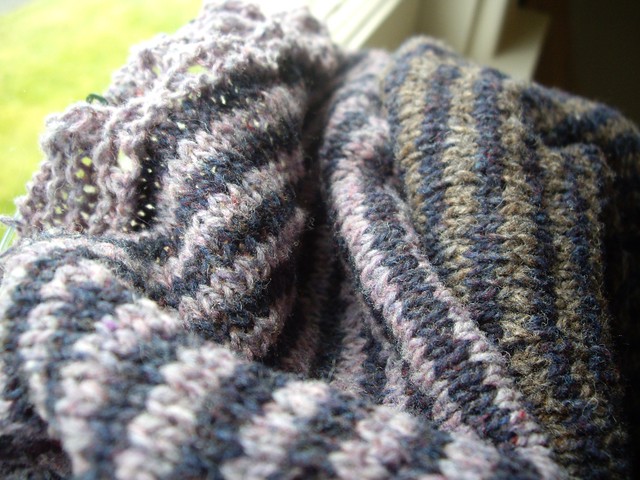
And I am working on the lace edging for Cladonia, these are long rows now:


And I'm still working on my blouse. Here's a snippet of the fabric, upcycled from a men's shirt that I bought in ... Australia, maybe? From the op shop, brand is Blazer, it's a medium-weight cotton with this little dark blue print of sprigs. It looks just like a patchwork print but the material is heavier.


I managed to totally muck up the front yoke facing so it wasn't sitting nicely at all. Now that I have removed it, it appears that the front yoke and front yoke facing are completely different shapes ... not at all sure how I managed that. Am trying to maintain momentum in order to actually finish it (rather than resorting to the more pleasant task of cutting pattern pieces out for a different blouse. I've only done one so far).

Wednesday, 18 July 2012

attitude adjustment

So after my recent mini crisis of confidence in the sewing field, I took a deep breath and just got down to it. I think part of it is just accepting that it's a learning process and that there are going to (possibly, likely) be a few iterations.

I laid out my front side pattern piece and cut into it, lowering the bust apex, spreading the pattern piece out, closing the resulting dart, inserting extra tissue paper and taping it all together. It was, like most things when you follow the directions, easy.

Then yesterday evening I cut out the front, back and side pieces from calico and stitched it up. It was a bust (pardon the pun but was one ever more apposite?) Didn't fit - I had lowered the bust apex too far and hadn't added enough in the bust and will have to start over again. BUT, even with these shortcomings, I saw the shape of things to come, a top that is going to fit me. As soon as I get a free half hour or so (which really, is as long as it takes to do the fba as per the instructions that come with the pattern) I'll give it another shot.

And I'm delighted that I didn't even cut into or waste a shred of my super-cute fabric, upcycled from a French Connection blouse purchased second hand.

Saturday, 9 June 2012

three cheers!!

Sewing trifecta - hats, tunique francaise and now this Nani Iro number:


The Vital Statistics
Pattern: Dress U from nani IRO by Naomi Itou (isbn 4579111834 / 978457911183).
Size: I can't remember ... needless to say, it no longer fits the intended recipient (miss bear) but has found a wonderful home up the street with a three-year old.

Fabric: Linen/rayon blend salvaged from a White Stag bias-cut skirt (which was great because the fabric was already set on the bias), purchased at the thrift store.
Start to finish: Started sometime after we returned from Savannah in October 2010 and completed on 4 June 2012.
Stash/recycle content: 100 per cent - hooray! Button was from stash.

Comments: Again, it was the bindings that did me in. And the little square patch with some gathers underneath it there on the front. I also couldn't get the opening at the back to lie flat - maybe something to do with the dreaded binding? I also simply made my button loop out of the sewing thread rather than the fabric which i thought would get too bulky and couldn't, um, really be bothered with at this late stage anyway. 

Verdict: Very pleased that I actually finished it. The fabric was a great choice for this dress, the colour, the coin spot, the blend.
The front and back are actually cut from two pieces - in the photo of the back you can see the diagonal seam along the bottom corner of the dress. I think that this is design to make the most of the print on the fabric from which the dress is made in the book. It also serves to make the dress asymmetrical but I don't think is necessary if you are not emphasising a feature of the fabric print; that is, I could have cut the back and front in single pieces. I also wonder what might happen to the hang of the dress is that piece were cut on the grain instead.

I have another bias-cut skirt waiting to be up-cycled ....

Tuesday, 5 June 2012

tunique francaise - finis!

Two years later, I present:

The Vital Statistics
Pattern: Tunique froncée from Intemporels pour Bébé: modèles et patrons de 0 à 3 ans by Astrid Le Provost.
Size: Umm, can't quite remember now. I think that I made the largest size (3 years) and lengthened it to use up as much of the fabric as possible.
Start to finish: Hmm, first mentioned on this blog on Thursday, 13 May 2010. I finished it on Monday, 28 May 2012.
Stash/recycle content: All of it - hooray! The paisley was a Goodwill purchase and the brown trim came from a dress that I bought at a yard sale and had previously used for some sewing. The shell button came from stash.

Comments: Not sure if the patterned fabric is really the right thing for dressmaking. I suspect that it is more quilting cotton than dressmaking cotton but hey, it's turned out well. I didn't end up making it as long as I had planned and instead sewed a deep hem on it, thinking that it might need some weight to sit well. And it does. Also, French seams - lovely.

And the amazing delay in getting it done? There must be something about my attention span and the process of sewing. Bindings come towards the end of the project (neck and cuffs in this case, and inserting elastic which I hadn't done before), right when my patience is wearing thin and that is enough to have me set something aside for a while. Turns out that it took two years for my attention to roll back around to this one. I have another girl's dress just waiting on the bindings - the only way that I can date it is that I'm using a linen/rayon blend from a skirt that I bought at a thrift store in Savannah ... (October 2010).

Verdict: Miss bear wore this three days in a row - definite success.

Tuesday, 29 November 2011

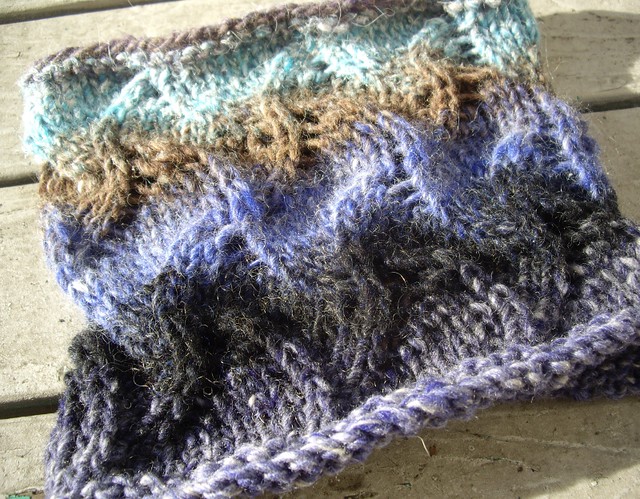
reclemence

I recently ripped out the Clemence cowl that I knit in June last year. It was really sad to do this because I loved it but it was even sadder that I wasn't wearing it because it was too loose. So I reknit it with one less repeat width-wise and on a smaller needle.

The Vital Statistics
Pattern: Clémence by Katya Frankel, available for free through Ravelry.
Size: I cast on 63 stitches as I was using a heavier yarn than that which the pattern calls for.
Yarn: Noro Transitions in shade 21 purchased at Lake City Way Value Village.
Needles: 6.5mm.
Start to finish: 26 to 27 November 2011 and then wove the ends in the next day.
Stash/recycle content: Yes!
Comments: Great pattern, easily memorised, great for a self-striping yarn as the combination of increases and decreases every row really breaks up the chunks of colour.
Verdict: It is lovely again. Actually, hard to discern from the original but I hope that I'll wear this more often.

Sunday, 20 November 2011

riding the wave

So now that I have some screen printing under my belt I'm gung-ho to do it all over the place. Miss bear was not prepared to wear this blue fine wool t-shirt when it was 'clear' (her term for plain), she wanted it fancy so we printed the waves/clouds patterns onto it in silver. It came out reasonably well. She is yet to wear it but hey, I made the effort. The t-shirt is a thrift store purchase.

Wednesday, 16 November 2011

handprinted: catching the wave

Well phew, I didn't drown! Actually, these look more like clouds don't they? I have been thinking of them as crashing waves, like really rough surf. perhaps because I had a pretty rough time getting these done.

I was so inspired when I became aware of this fabric swap - oh and an apology to my swap partners or Leslie the organiser if they happen to be reading this, the responsibility for taking this on was completely my own and I was delighted to participate but do have to be honest about the process - and jumped right in without really thinking what it would be like for me to have a deadline. Now I know - not good.

When it's up to me I work furiously on things for a few days, or even weeks if I'm lucky, then let them lie fallow until the creative spirit moves me again. This can take a long time. I also make my stuff at home, by myself, no requiring any technical assistance which is why it can also take a long time if there's a thread colour I need, or a type of ink. Needless to say, this style of making stuff is not really compatible with a deadline and a screenprinting project that was really beyond my at-home resources.

LinkFirst of all, I had to burn the screen, that is use a light-sensitive photo emulsion to create the screen image ready for printing. No, first I had to buy the screen, a big one to make a fat quarter size print. And for that I went trekking across town, kids in tow, to an industrial screenprinting place that sold me a used one for $15, once I found them in an old building in Interbay, down a flight of stairs and through a door, and down a hallway. Actually, that bit was quite fun - I enjoy exploring.

Then I bought the photo emulsion and a pouring device and the light bulb for the exposing and then decided that I just couldn't face it and booked in some time at the Vera Project's silk screening studio. That didn't turn out so well - apologies now to the Vera Project in general because I think they have a great facility and programs going there - but the day that I went in the guy 'helping out' in the silkscreening studio was a total ... if I used the same language that was in the music that he had playing in the studio, I would have to rate this post 18+.

I mean, the screen got burned fine (although not large enough so I didn't manage to print fat quarters) but I found the whole experience incredibly demoralising. Perhaps it was just my own self-consciousness about being there (which was sky high), that I wanted to ask them to turn off the insulting music but didn't dare and then was frustrated with myself, didn't really know what I was doing and wasn't getting any help - whatever. Anyway, I felt really old.

But, I got four pieces of re/upcycled linen printed with the image of a block print that I made, taking the design from the end papers of an old book. They are not great - the printing is not great, they are not large enough - but they are done and I am happy with the visual effect and I stayed true to my values by using recycled fabric. I particularly like the slightly offset version where I used the black and silver. And I got awesome swap fabrics in return (more on those next time).

Friday, 28 October 2011

micro-tidying

So yeah, what would the world look like if everything got used and re-used and mended until it had totally exhausted its usefulness?

I can begin to see what this would look like for consumption because this is what I am already trying to do myself: it looks like a t-shirt that gets a patch on it, rather than being thrown away; knitwear made from other knitwear; clothes made from other clothes; recycled buttons and zippers; and last but not least, an extra $56.00 to spend on ... um, groceries? And to me, that looks great. How far can it go though? Is there a future where there is more respect for the eco-consciousness of a patched business suit, for instance, than for brand new attire?

And what would it look like for production? If demand for newly manufactured items decreases, what sort of shift will there be in the labour market? I recently attempted to sew myself a t-shirt because I'm not entirely comfortable with the cheap made-in-Sri Lanka ones that I'm currently wearing. I don't know what sort of working conditions they were manufactured under, what sort of emissions the factory made, what carbon cost there was in transporting them to the US; and I care about these things. I also care about the welfare of women in Sri Lanka: one less t-shirt purchased by me may not make a huge difference but if everyone stopped buying them ...

I'm also aware that in order for me to re-use something it has to be manufactured and bought new by someone else in the first place. But what is the tipping point? If everything that already existed were to be re-used to the end of its usefulness, how much would need to be manufactured anew? I have no idea but I find it fascinating to consider.

Anyway, to get around to the point - I made an attempt to tidy up my craft space recently. Tim always gets so frustrated with my efforts at tidying because I micro-tidy, I look at each thing, consider it and deal with it. His version of tidying is to put all the offending mess and paperwork in a drawer (and then wonder why the electricity bill didn't get paid). The other day I got no further in my efforts than some sweater pieces that I cut out goodness knows how long ago (I truly don't remember) that have been sitting there on the table ever since, waiting to be tidied up. So tidy them up I did by sewing the actual sweater.

It's for baby b, recycled from a men's sweater that I bought at the thrift store, 100 per cent wool. I had to cut the front out in two pieces because the sweater had holes in it, so I put on some decorative red stitching; it's never a mistake, it's a design feature. I also cut the pieces to take advantage of the existing hems and cuffs so the only binding that was needed was around the neck. This is a great fit for him right now, a perfect transitional layer, but I can't for the life of me remember what pattern I cut it out from (it's been that long). And one of the great things about upcycling clothing is that you get children's clothes in colours and textures that you just can't find otherwise.

Wednesday, 19 October 2011

thriftonomics (still rambling)

So back to those snipped-off buttons: why the (perceived) disdain from an older generation that I am doing by choice something that they perhaps once had to do by necessity? It seems that at one point brand new and shiny became cheap and accessible and also preferable.

I had never much thought about economics as anything much beyond "the economy" until I did that Health Economics subjects. And “the economy” has always been something monolithic that I am all too aware that I don't understand well and am therefore hesitant to write much about. But with wikipedia everyone's an expert so here goes: economics is "the social science that analyzes the production, distribution, and consumption of goods and services." I like to think of it in terms of flow, the flow of money in and out, the flow of goods production and disposal. I also like to think of it as a closed system, to recognise the finite nature of our resources.

And I do think that there is a finite number of zippers in our world and in our future; to throw away a worn out garment with a perfectly serviceable zipper still attached, to let it rot and rust, is unconscionable.

I’m sure that I have written before about the amazing mother lode of goods that are available at thrift stores here in the US (well, here in the Seattle area certainly but I’ve visited some pretty huge ones in San Francisco, Chicago, Salt Lake City and Georgia now too). I often wonder when I am there, what if everything here in this store were utilised straight away, if everything reusable were indeed reused, instead of something new being manufactured and purchased?

Please consider the Primigi girls shoes above. One pair was purchased online for $60.00 and has been worn for a couple of weeks. The other pair is the next size up and was purchased at Value Village for $3.99. They are in roughly equivalent condition. That's $56.00 to spend on ... ah, groceries?

Saturday, 1 October 2011

september reading (and a ramble)

United States of Americana: Backyard Chickens, Burlesque Beauties, and Handmade Bitters: A Field Guide to the New American Roots Movement by Kurt Reighley - This is an interesting book that covers a number of aspects of current American life and culture that are harkening back to 'roots', things like home canning, straight razor shaving, bluegrass, knitting, taxidermy and speakeasies. Reighley is Seattle based so I enjoyed it that there was a lot in here that is local to me.

I enjoyed this book and it really got me thinking about 'old times' and the return to doing things in a deliberate, hands-on, 'old-fashioned' way. Back in 2oo8 when I attended the Stitches and Craft Show in Melbourne, I was actually a little disconcerted by some of the older women who looked at my recycled yarns and garments and, umm, scoffed (no, that's too harsh but a lighter shade thereof) that they used to do the same "way back when".

Yes, I save buttons and zippers off worn-out garments, in fact I save worn-out garments, with the hope that I will one day get around to using them to make something else. And yes, I do realise that I am not the first to be doing so, but I do feel that I am part of doing things that way again.
And whereas this sort of thrift in the past was probably a necessity (Tim suggests also a manifestation of Protestant values) today for me it is about an ethical choice for sustainability (and yes also for saving money but I just seem to spend that on more craft supplies!).

Further, recently the Modern Quilt Guild called for submissions of 'modern quilts' to be part of an online exhibition. I had hoped to submit something - maybe the turbulent river baby quilt or the Franco-Australian wagga - but I found myself a bit stuck on the prompt "what, in your opinion, makes it modern." What is modern about my quilting? Certainly not the colours that I use, not the shapes, not the techniques - just that I do it in a really old-fashioned way. Which seems to be new all over again.

Thursday, 25 August 2011

jarrett

Hooray!

The Vital Statistics
Pattern:
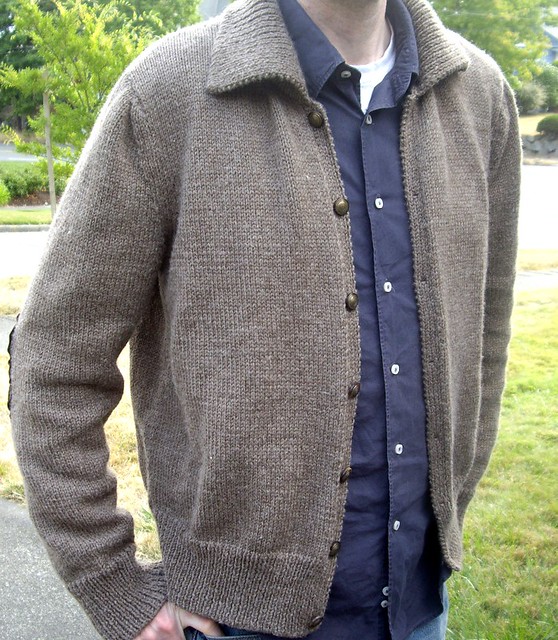
Jarrett by Kim Hargreaves from Rowan's Vintage Style.
Size: Medium with extra length in the arms.
Yarn:
Cascade 220 in shade Walnut Heather; almost eight skeins.
Needles:
4mm and 4.5mm.

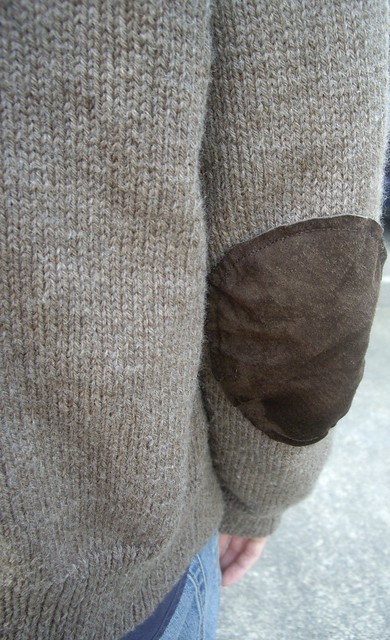
Stash/recycle content: Just a little bit. I added elbow patches that I cut out of a rather ugly suede skirt purchased at Bellevue Goodwill. I actually bought the skirt to cut out elbow patches to mend a friend's husband's sweater but the suede turned out to be just the right shade for this project too.
Start to finish:
15 March to 13 August 2011 - five months, not bad.

Comments: I put a lot of effort into this knit! I learned and used the long-tail tubular cast-on for hems and cuffs, cast off the neck in similar fashion (not sure where the link is for that one but it involved Kitchener stitch), lovingly knitted the button and buttonhole bands until they fit when gently stretched, single-row buttonholes, a row of slip stitch crochet to reinforce the neckline, and quite a lot of stocking stitch.

I did knit the moss stitch elbow patches and shoulder flaps, I even crocheted around the edges to try and neaten them up but they just didn't work for me. Instead I sewed on very professorial leather elbow patches and dispensed with the shoulder flaps altogether.

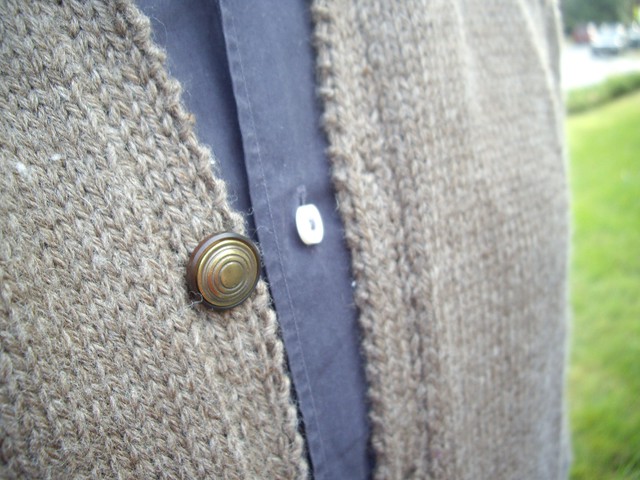
The buttons we purchased together at my beloved The Button Shop in Melbourne when we were there in April.

Verdict: Pretty happy. Tim is over the moon that I have finally knit a garment for him (this was my first men's garment!) The fit is good in terms of the size I chose and the sleeve length but still I think the design itself is a bit roomy in the upper sleeves.

Oh and that old-fashioned knit-the-button-band-separately construction is such a pain. And so outdated. Knitting this has made me really curious to take a closer look at the seamless knits that are around. Sometimes it seems as though new designs are just the same old cardigan or sock with a different lace stitch plugged in but seamless construction, top-down set-in sleeves - it's exciting that there is still room for innovation in knitting. Speaking of which, next up for Tim is Brownstone in brown; ok, 'espresso'.

Wednesday, 20 July 2011

kashmir

The Vital Statistics
Pattern
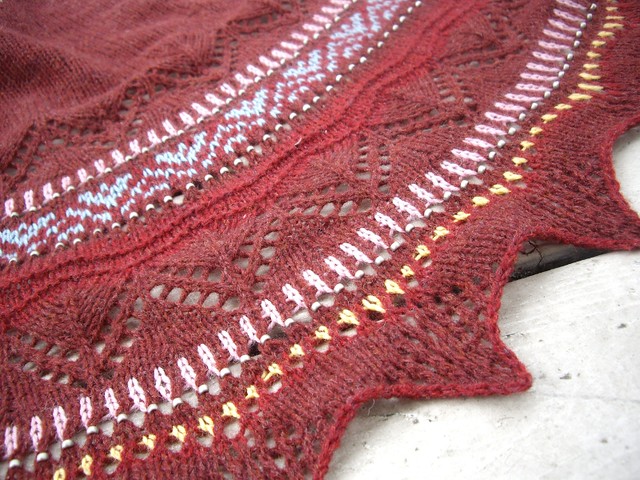
: Nine Lives by Kieran Foley of knit/lab.
Yarn: Recycled red heathered wool and burgundy heathered wool from an Old Navy vest and a J Crew sweater respectively (thrift store purchases), supplemented with Rowan Pure Wool 4ply in Eau de Nil, Vintage and Gerbera.
Needles: 3.75mm.
Start to finish:
6 June to 17 July 2011.
Stash/recycle content:
Mostly. I purchased the Pure Wool 4ply in Vintage for this project, the Eau de Nil I had from a while ago and the Gerbera came from another raveller. I also purchased the matte silver beads.
Comments: This was my second attempt at this design, the first colour scheme not being to my liking. I changed around the colour progressions too and knit only two instead of three garter stitch ridges. This was my first project that incorporated beads; it was slow but fun to do. I'm really glad that I found matte silver beads (Fusion Beads in Seattle, wonderful place).
Verdict:
Knit/lab patterns are fantastic and if you feel like knitting some wonderful lace, elegant stranded colourwork or a combination of both, I highly recommend a look at the available designs. I'm going to have fun wearing this.

Friday, 1 July 2011

faux prussian stole

I did it!!

The Vital Statistics
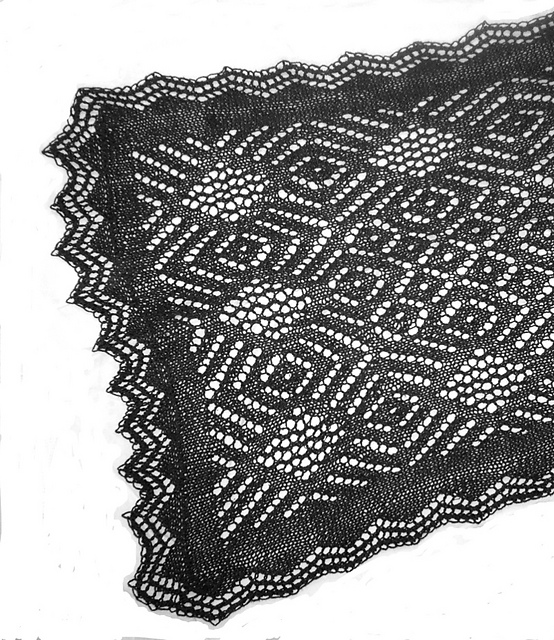
Pattern: Faux Russian Stole by Katie Nagorney and Ann Swanson from A Gathering of Lace.
Size: I only did four-and-a-half of the lace panel repeats instead of five and a half. The finished stole measures 56 by 178 centimetres (22" by 70").
Yarn: Recycled!! Cotton/linen/silk blend from an RL Polo top purchased at Value Village in Redmond.
Needles: 4mm Addi Lace.
Start to finish: 22 March 2009 to June 22 2011; 27 months.
Recycle/stash content: 100 per cent, so lovely. This stole cost about $6.00.
Comments: Well, clearly this took me a really long time to knit. It was a slog, two years and three months. The lace repeat for this design is 81 stitches wide and 96 rows deep which means that you have to keep looking at the chart all the time, and counting all the time. There are both k2tog and ssk decreases, depending on what direction the eyelets are running, and I often had to move my markers around in order to make the decreases which initially drove me nuts.

I did one less of the central lace repeats and am very happy with the length that the stole blocked out to. Had I done that one more it would have been too long.

Verdict:
Stunning! I'm very happy with this and delighted that it has turned out so well. Two years ago when I blithely cast on for it, I don't think that I had such a good understanding of yarn/pattern compatibility but this has worked out really well.

Monday, 13 June 2011

second life

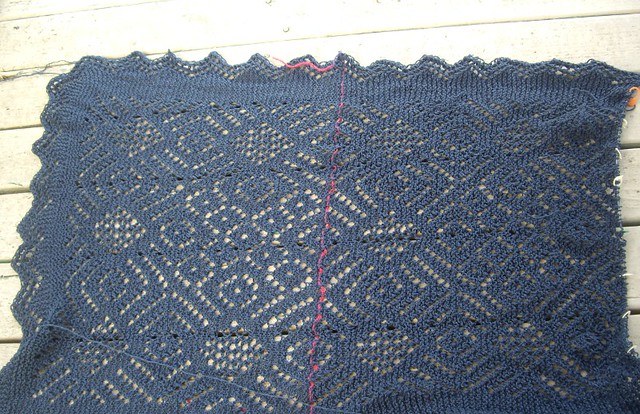
I have cast on again for Nine Lives using some burgundy lambswool recycled from a J Crew sweater. So far I have the set up section and Chart A done; now it's time for the first colourwork chart and I really don't feel up to it. I have been working really hard on my Faux Russian Stole (21 out of 34 edge repeats complete) which is so attention-intensive that I all I really want at the moment is stocking stitch, long stretches of stocking stitch.

I also can't remember whether I decided to use pink, blue or yellow as my contrast colours. Maybe all of them? Anyway, going to hibernate this for a while while I consider. It will live to see another day.

ps. Ha, ha - just checked my last post on this; I had decided on the pink and blue as contrast colours. Thank goodness I write these things down, somewhere.

Monday, 16 May 2011

resolute

It's almost half way through the year (yes, really), so a good moment to stop and check up on my new year's resolutions.

Reading - yes, not as much as last year but at least one book each month. I dealt with one of my old projects by frogging it (farewell diamond mittens); the quilt and socks I haven't even thought about yet. Jarrett for Tim is coming along well but I have hit that strange 'almost finished, best stop working on it for a while' hiccough. Stash and recycled crafting are going strong but I have also bought quite a bit of yarn for projects so far this year too.

What's really coming along well is my Faux Russian Stole. This is one of only two projects that I took with me to Australia in order to force myself to work on it, being deprived of any distractions. Last mention of any progress on this was February 2010 and my notes in Ravelry are similarly sparse. So, sometime in April this year I was working on edge repeat number 10; within a month, I have now finished edge repeat 17 which makes me half-way through. Half-way through!! (And a bit further even than in the photo).

What is interesting is how this has become quite easy knitting for me; or rather, it is nowhere near the challenge that it was when I started it. Having to move the stitch markers, pay close attention constantly to the chart, count carefully every other row, alternate between k2tog and ssk decreases all over the place, none of this really bothers me now. I can sit and knit a dozen or so rows of this in one go without too much ill effect. So there we have it, one advantage of leaving a project for so long, ahem, that is, coming back to a long-left project, is that you get to experience your development as a knitter.

Monday, 9 May 2011

la waggá

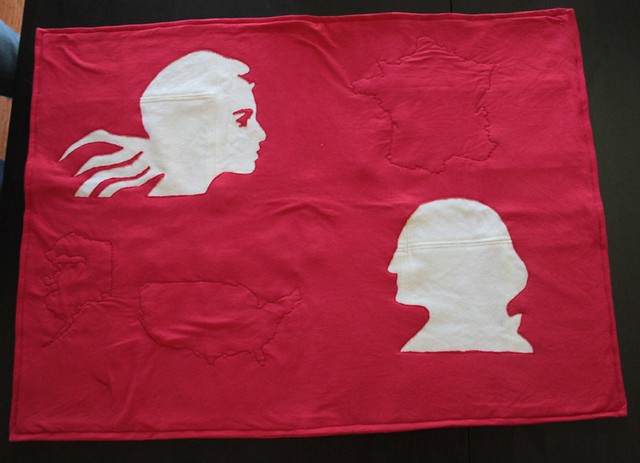
French friends of ours whom we met in Australia, who also live here in Seattle, recently had their first child. What better opportunity to produce the world's first (I'm guessing) Gallo-Australo-American wagga?

The patchwork woollen blanket was actually sewn up about a year ago from pieces cut from a blazer that I bought at the op shop. As the baby's mother is allergic to wool, and even though I'm not sure whether that is a heritable condition, I wanted to encase the blanket in cotton as much as possible. I acquired a good amount of red cotton jersey courtesy of a Tommy Hilfiger sheet set that I bought at a thrift store here in Seattle and used that to mostly encase the blanket. I also figured that this would be softer against the baby's skin.

One of the things that has struck me living and driving here in Washington state is the wonderful graphic of George Washington's profile that is used on the road signs for the state routes. It reminds me of the Queen's profile on English postage stamps (although as someone here quite annoyedly pointed out to me, Washington was not the king of the United States; ah, yes).

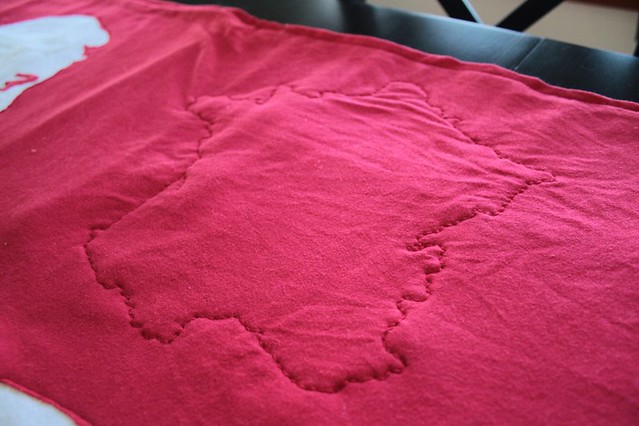
Anyway, as our friends are also from elsewhere, living here, for decoration on the quilt I wanted to combine some cultural graphic icons so I chose Washington's profile and also that of the Marianne, the national emblem of France. The profiles are done in reverse appliqué - I placed the cotton jersey onto the woollen blanket and machine stitched around the image with a ball-point needle and tiny stitches, then carefully cut away the fabric inside.

The rest of the space on the quilt needed something so I transferred the outlines of both France and the United States to the top and used running stitch to further quilt the layers together. I stitched around twice, so there are no gaps between the stitches.

I must admit, I'm really happy with this quilt and also excited by it. Happy because it turned out so well, because I love the old-fashioned feel of the deep red against the cream, with the witty imagery (if I may say so myself).

Excited because finally, after probably about four or five years of thought, I finally realised a modern wagga as I have had in mind all that time. And because it is done completely from recycled materials - even the embroidery thread was from an unravelled cotton sweater. Yes, there is also the one that I started for my own baby boy, who at one and a half is hardly a baby any more. And yes, I'm still working on it, stitch by stitch.